
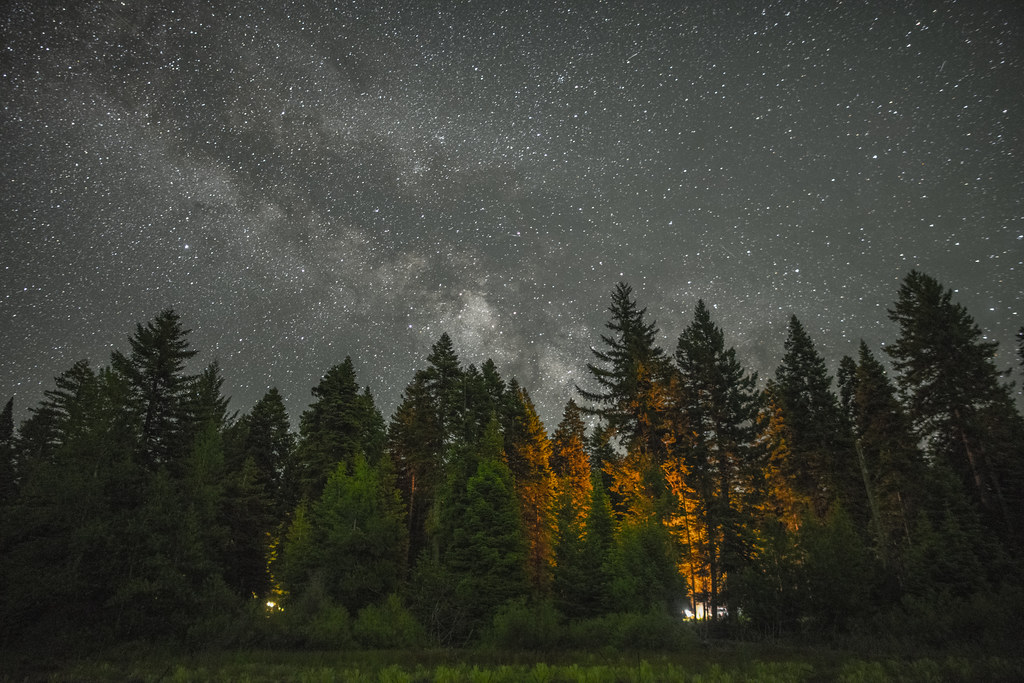
Stargazing in Southern Oregon: An Insider's Guide to the Darkest Skies
Dark sky destinations and viewing tips from inside the Cascade-Siskiyou National Monument
Finding the Perfect Stargazing Basecamp
Step outside at midnight and the first thing you notice isn’t the sky. It’s the silence. No hum of traffic. No neighbor’s porch light. Just the sound of wind through pines and, somewhere in the dark, a flammulated owl calling from a branch you can’t see.
Then you look up.
The Milky Way stretches across the southern sky in a band so dense it looks like someone scattered flour across black granite. You’re standing on the deck of your cabin at 4,500 feet, deep inside the Cascade-Siskiyou National Monument, and you haven’t seen a sky like this since you were a kid. Maybe not even then.
Southern Oregon has quietly become one of the best regions for stargazing in the United States. And if you know where to look, you don’t need to drive five hours into the desert to see real stars.
Southern Oregon’s Dark Sky Revolution
Something is happening in southern Oregon that most people haven’t noticed yet. While cities across the country grow brighter every year, this corner of the Pacific Northwest has been moving in the opposite direction.
In March 2024, the Oregon Outback Dark Sky Sanctuary earned certification from DarkSky International. It spans 2.5 million acres of high desert in Lake County, making it the largest dark sky sanctuary in the world. The organization behind it plans to expand the boundary eastward into Harney and Malheur counties, eventually covering 11.4 million acres of protected night sky. That’s an area larger than Switzerland.
Later that fall, Oregon Caves National Monument received its own certification as an International Dark Sky Park. Crater Lake National Park, two hours northeast, offers high-altitude viewing over its caldera at 7,000 feet, where the thin dry air makes stars look like someone turned up the contrast.
Southern Oregon now has a network of dark sky destinations stretching from the Illinois Valley to the high desert, from volcanic calderas to old-growth forest. Travel Southern Oregon’s stargazing guide maps the full corridor. And sitting right in the middle of it, where the Cascade, Klamath, and Siskiyou mountain ranges collide, is one of the darkest and most accessible spots in the region: the Cascade-Siskiyou National Monument.
Why Cascade-Siskiyou Is the Sweet Spot
Most people know the Cascade-Siskiyou National Monument as the only national monument in the U.S. created specifically to protect biodiversity. Three mountain ranges converge here, producing over 200 bird species, rare plants like Gentner’s fritillary, and ecosystems that change dramatically every half-mile.
But the same remoteness that protects all that life also protects something increasingly rare: genuine darkness.
Three things eliminate light pollution: distance from cities, elevation, and terrain that blocks stray light. The monument has all three. Ashland sits 17 miles to the west, population 21,000, small enough that the ridgeline between town and the monument absorbs most of its glow. Medford is 30 miles northwest, but the Cascades stand between you and it. To the east and south, nothing but national forest for 50 miles.
At 4,500 feet, you’re above the valley haze that traps light and moisture at lower elevations. The air is thinner and drier, which means sharper stars and better contrast. On the darkest nights, the Milky Way is bright enough to cast faint shadows on the ground. The Andromeda Galaxy is visible to the naked eye. No telescope. No app. Just 2.5 million light-years of photons landing on your retina while owls call through the trees fifty yards from your deck.
And unlike the Oregon Outback, which requires a five-hour drive into some of the most remote country in the lower 48, the monument starts 20 minutes east of Ashland on Highway 66. You can eat dinner in town, drive into darkness, and be standing under the Milky Way before 10 PM. Green Springs Inn sits inside the monument on over 100 acres of mixed conifer forest. The BLM’s Cascade-Siskiyou contact station is on the property.
That’s the thing about this place. You get the darkness without the expedition.
The Path Toward Dark Sky Certification
The monument’s night sky already speaks for itself. Now there’s a push to make it official.
The Bureau of Land Management has been working toward International Dark Sky Park certification for the Cascade-Siskiyou for several years. Kyle Sullivan, a BLM public affairs specialist with the Medford district, has called the night sky “one of our most endangered resources.” The agency has installed light-monitoring devices to document sky quality across the monument and is planning to retrofit lighting at Hyatt Lake and other BLM facilities with shielded, downward-facing fixtures that don’t scatter light into the atmosphere.
The dark matters beyond what we can see. The monument’s bat populations and nocturnal pollinators depend on natural light cycles that artificial illumination disrupts. The same darkness that reveals the Milky Way keeps the nightshift running for three species of owl: Northern spotted, flammulated, and pygmy. Protecting the sky protects the biology.
Paul Atkinson, a 2025 artist-in-residence at the monument, has been documenting the night skies through photography, building the visual case for why these dark corridors deserve formal protection. The Friends of Cascade-Siskiyou and BLM have organized stargazing events and astrophotography workshops as part of the monument’s summer programming.
There is currently no DarkSky Approved Lodging anywhere in Oregon. Green Springs Inn is working to change that.
The designation isn’t official yet. But if you stand in the amphitheatre on a moonless night in August, you won’t need a certificate to tell you what you’re looking at.
Where to Stargaze Near Ashland
Your cabin deck. I tell guests this all the time and they think I’m underselling it. Our cabins sit in clearings surrounded by forest inside the monument. No streetlights. No highway glare. Walk outside and you’re already stargazing. Three cabins offer the widest sky views: Parsnip Lakes, Mayfield Gardens, and Chinquapin Mountain. Each sits at the edge of a clearing where the tree canopy opens up and gives you an unobstructed arc of southern sky. If stargazing is the reason for your trip, request one of these three when you book your cabin.
The amphitheatre. A short walk from the cabins and lodge, our amphitheatre is a grass clearing surrounded by tall trees with open sky overhead. Spread a blanket on the grass or sit on the wooden stage. On a moonless night, the clearing frames the sky like a window cut into the forest. This is where couples end up at midnight, lying on their backs, having conversations they wouldn’t have had at home where the phone is always within reach. Out here, the phone is useless and the sky is doing all the work.
Hyatt Lake. Ten minutes north on Highway 66, the lake’s open water gives you something the forest can’t: reflections. The Milky Way doubled in the surface of the water. Astrophotographers use the shoreline here because you can shoot stars without hiking in the dark. The BLM campground keeps lights minimal.
Pacific Crest Trail crossings. The PCT crosses Highway 66 near the inn. Hike 20 minutes in either direction and you’re in darkness so complete your eyes take a full 30 minutes to adjust. Bring a red headlamp and leave the phone in your pocket.
For dedicated dark sky parks farther afield, Oregon Caves National Monument is about two hours southwest. The Oregon Outback Dark Sky Sanctuary begins about three hours east into the high desert. If you’re planning a dark sky road trip through southern Oregon, Green Springs Inn makes a natural base camp: dark skies right outside your cabin door, with both destinations within a day’s drive.
What You’ll See, Season by Season
Summer (June through August) is peak season. The Milky Way’s galactic core, light that left its source 26,000 years ago, rises in the southeast after dark and arcs across the southern sky by midnight. At 42 degrees north latitude, it stays in the southern half of the sky rather than passing directly overhead, so south-facing clearings and cabin decks give you the best angle. The Perseid meteor shower in mid-August is the highlight. It’s warm enough to lie on a blanket in the amphitheatre and watch streaks of light burn across the atmosphere.
Perseids 2026: This year's peak, the night of August 12-13, lands on a new moon, the best viewing conditions until 2029. Timing, where to stand, and the full night sky calendar are in our Perseid meteor shower guide.
Fall (September through November) brings fewer visitors and sharper skies. The air gets drier and colder, which means better contrast and less atmospheric distortion. The Andromeda Galaxy appears as a faint smudge to the naked eye. The Orionid meteor shower in October is underrated.
Winter (December through February) delivers the clearest nights of the year. Orion, Sirius, and the winter hexagon are visible by 7 PM. The Geminid meteor shower in December is the strongest annual shower, producing up to 120 meteors per hour under ideal conditions. Temperatures at 4,500 feet drop well below freezing. The cold is part of the deal. The stars are worth every layer.
Spring (March through May) is the transition. The Milky Way core rises after midnight in March, earlier each week. By May it’s up by 10 PM. The Lyrid meteor shower peaks in late April with 15 to 20 meteors per hour. Spring storms clear fast at this elevation, leaving the sky rinsed and sharp.
Tips for Your First Night Out
Give your eyes 30 minutes. Your pupils need a full half hour to adapt to darkness. That means no phone screen, no white flashlight, no headlights. The difference between 10 minutes and 30 minutes of adaptation is the difference between seeing the Milky Way and seeing the Milky Way’s structure.
Use a red headlamp. Red light preserves your night vision. White light resets the clock. Every time you check a text, you lose 30 minutes of dark adaptation.
Check the moon phase before you book. A full moon washes out everything but the brightest stars. The week around a new moon gives you the darkest skies. TimeandDate.com has a free lunar calendar.
Bring binoculars, not a telescope. A decent pair of 7×50 binoculars shows you Jupiter’s moons, the Orion Nebula, and star clusters invisible to the naked eye. Easier to aim, lighter to carry, and they fit in your day pack for the trails around the inn.
Download a sky map app before you arrive. Stellarium (free) or Sky Guide will identify anything you point your phone at. Use the app’s night mode so the screen stays red. Cell service is limited up here, so download offline data before you leave Ashland.
Dress warmer than you think. Even in July, mountain air at elevation drops fast after sunset. Bring layers you’d wear in November. Your future self, lying in the amphitheatre grass at 1 AM watching a meteor shower, will be grateful.
Plan a Night Under Southern Oregon's Stars
Green Springs Inn sits inside the Cascade-Siskiyou National Monument at 4,500 feet, where the darkness is the real thing. Pick a moonless night. Dress warm. Give your eyes time to adjust. The stars will be here tonight. The question is whether you will.
Keep Exploring
- Fall Hikes Near Ashland, Oregon: Hike the Name on Your Cabin Door
- Rogue Valley Wineries: A Harvest-Season Guide from Ashland’s Mountain Side
- Perseid Meteor Shower Oregon 2026: Sleep Where You Watch
- Hyatt Lake Oregon: Your Complete Guide
- Hiking Southern Oregon: 10 Best Day Hikes from Green Springs Inn
- Explore the Cascade-Siskiyou National Monument


